When you're ready to use your frozen eggs, you'll work closely with your fertility team to create a plan that's right for you. The exact process depends on your goals, whether you want to try to become pregnant now or create embryos to use in the future.
Step 1: Create Your Treatment Plan
The first step is deciding how you'd like to use your frozen eggs. You'll choose a sperm source, either from a partner or a donor, and your fertility team will recommend a treatment plan based on your goals.
If you're hoping to become pregnant now:
If your plan is to thaw your eggs, fertilize them, and transfer an embryo during the same treatment cycle (without pre-implantation genetic testing, or PGT), your uterus will need to be prepared for pregnancy.
This usually involves hormone medications such as:
Estrogen, which helps thicken the lining of the uterus so an embryo can implant. It may be taken as a pill, patch, or injection.
Progesterone, which helps maintain the uterine lining and supports implantation. It may be taken as a vaginal medication or injection.
Your doctor may also perform an ultrasound or other tests to make sure your uterus is ready for pregnancy. They'll also review your overall health, medications, and any medical conditions that could affect treatment. Careful timing is important so your uterine lining is ready when the embryo is ready to be transferred.
If you're creating embryos for later:
If your goal is to create embryos for PGT or to save embryos for a future pregnancy, you won't need to prepare your uterus yet. Instead, the focus is on creating healthy embryos and freezing them for future use.
Step 2: Thaw and Fertilize Your Eggs
Once treatment begins, your frozen eggs are carefully thawed in the embryology laboratory using specialized techniques designed to maximize their chances of survival.
A few hours later, the mature eggs are fertilized using a procedure called intracytoplasmic sperm injection (ICSI). During ICSI, a single sperm is injected directly into each mature egg to increase the chance of fertilization.
Step 3: Grow the Embryos
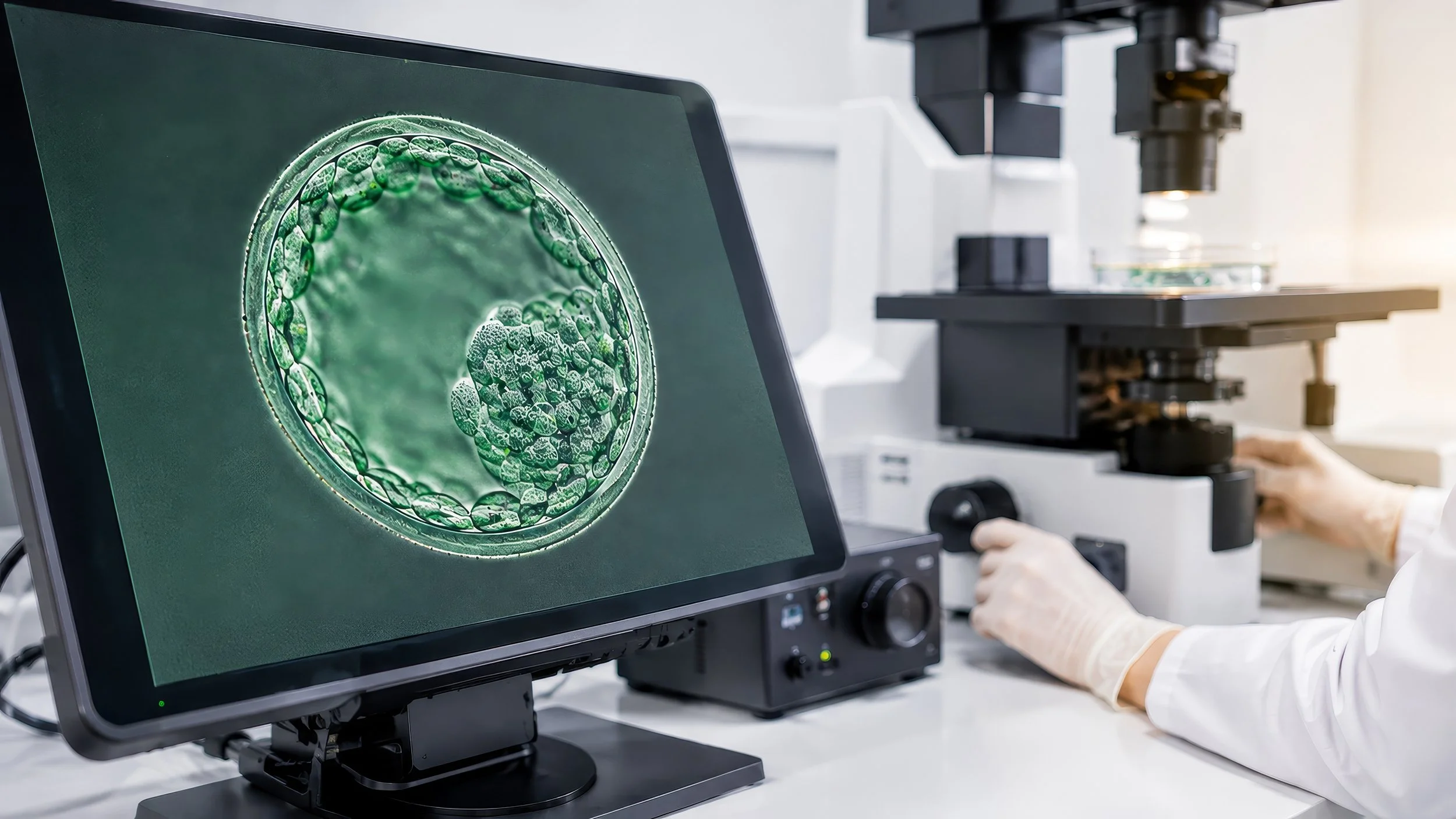
A blastocyst is small group of cells made up of two parts: an outer layer which becomes the placenta and an inner mass of cells which becomes the baby.
After fertilization, the embryos are carefully monitored in the laboratory for about five to seven days as they continue to develop. By this point, some embryos will reach the blastocyst stage.
A blastocyst is an embryo that has developed into a small ball of cells with two important parts. One group of cells will eventually become the baby, while the outer layer of cells will develop into the placenta (called the trophoectoderm), which supports the pregnancy. An embryo must reach the blastocyst stage before it can be transferred to the uterus or frozen for future use.
If you're having an embryo transfer:
If you're planning a fresh embryo transfer, one embryo may be transferred into your uterus around Day 5, as long as both the embryo and your uterine lining are developing as expected. Any additional healthy embryos can be frozen for future use.
If you're doing PGT:
If you've chosen to do PGT, the embryos that reach the blastocyst stage will have a few cells removed from the part of the embryo that later becomes the placenta (the trophoectoderm). This testing helps identify whether an embryo has the correct number of chromosomes.
The embryos are then frozen while the test results are processed. Once the results are available, you and your fertility specialist can decide which embryo to transfer in a future frozen embryo transfer cycle.
PGT can also reveal the sex of the embryo. You can choose whether or not you'd like to receive this information.
What to Expect
Your fertility team will guide you through each step and tailor your treatment based on your medical history, reproductive goals, and the number and quality of your frozen eggs.
It's important to know that not every frozen egg will become a healthy embryo. While modern freezing techniques have greatly improved egg survival, some eggs won't survive the thawing process. Of those that do survive, not all will fertilize successfully, and not every fertilized egg will continue developing into a healthy blastocyst.
This is a normal part of human reproduction and one of the reasons fertility specialists often recommend freezing multiple eggs. Having more eggs available increases the chance of creating one or more healthy embryos and, ultimately, achieving a pregnancy.
Your fertility team can also help you understand your individual chances of success based on factors such as your age when your eggs were frozen, how many eggs you have stored, and your family-building goals.

Dr. Alicia Broussard, PhD, is the Laboratory Director at Generation Next Fertility, a role she has held since 2021. She earned her bachelor's and master's degrees from Purdue University before spending 15 years as an embryologist. She later completed her PhD in Reproductive Clinical Sciences at Eastern Virginia Medical School (EVMS), home to the first IVF birth in the United States. Dr. Broussard is a certified High Complexity Laboratory Director and Technical Supervisor in Andrology and Embryology, and she also holds New York State Certificates of Qualification in Andrology and Endocrinology.
Learn more about Generation Next Fertility on Freeze.